
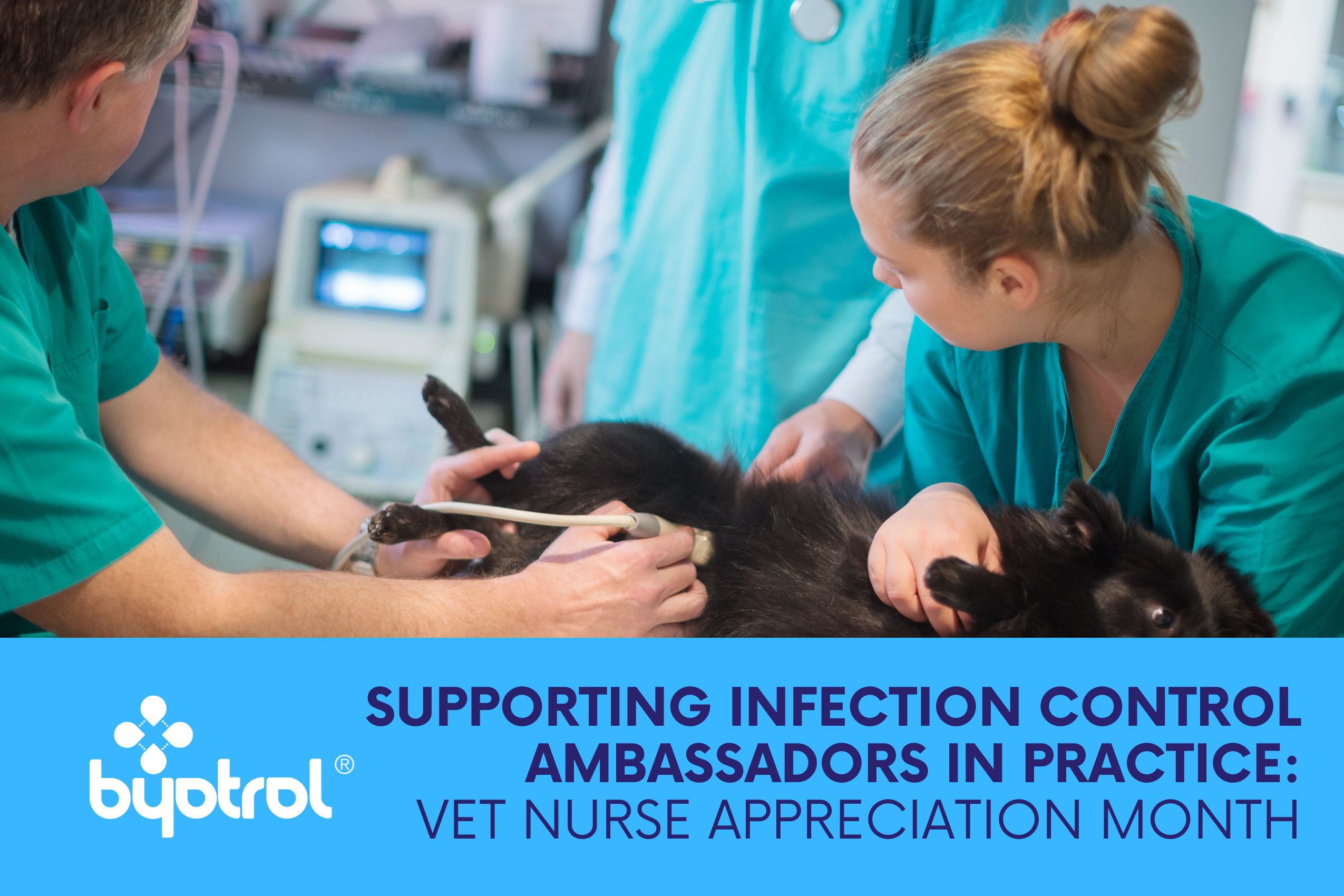
Every veterinary practice relies on strong infection prevention and control as the foundation for patient safety and confident antibiotic stewardship. It is typically vet nurses who make that happen. From preparing theatres and managing instrument reprocessing, to maintaining environmental hygiene standards across consult rooms, kennels and isolation areas, vet nurses sit at the centre of biosecurity in practice. It is detailed, often time-pressured work that requires both clinical knowledge and consistency.
During Vet Nurse Appreciation Month, it is worth recognising not just the importance of that role, but the need to properly support it.
At Byotrol, we take a simple view. Infection control only works when the whole team is confident, trained and supported to do it effectively and efficiently.
Why infection control support matters more than ever
Veterinary environments are complex. Practices are managing high patient throughput, changing disease risks and increasing expectations around clinical standards and sustainability.
At the same time, many teams are stretched.
We regularly speak to vet nurses who tell us:
- Protocols exist but have not been reviewed in years
- Training is inconsistent across the team
- Time pressures make it difficult to follow best practice every time
- Product choices are not always clearly linked to specific risks
These gaps are not about a lack of care. They are about limited time, competing priorities and access to the right support.
“Infection prevention and control sits at the heart of everyday veterinary practice. It affects not only patient safety, but also the health, safety and wellbeing of the veterinary team.
In busy clinical environments, keeping up with developments in IPC, including evolving guidance and changes in disinfectant technologies, can be difficult without practical support. Clear, confident protocols help teams work more consistently and efficiently, while also reducing uncertainty and stress in high-pressure situations.
Having the right training, processes and support in place helps create safer, more sustainable working environments for both patients and the people caring for them.”
Lisa Tolfree, RVN NCert (A&CC) PG Cert Ed and Infection Prevention and Control Manager UK for IVC Evidensia
This is where we focus our efforts at Byotrol.
Practical, accessible training for real-world practice
One of the biggest barriers to improving infection control is access to relevant, practical training. We have invested in free remote CPD-accredited training designed specifically for veterinary teams, with content shaped by real clinical experience.
Our training covers:
- How to build and maintain effective hygiene protocols
- Best practice for cleaning and disinfection across different areas of the practice
- The role of correct product selection and dilution
- Common gaps in infection control and how to address them
In FY26, our team trained over 2,000 animal health professionals, including a large number of vet nurses and clinical support teams.
Our remote training is designed to fit around practice life – our modules are flexible, relevant and focused on what works day to day, and practical to implement – as well as being free to complete.
For many practices, it is an easy and practical way to align the whole team in one go and then use the same module to onboard new members of staff when they join.
Bringing support directly into practice
Remote training is valuable, but there is also real benefit in working directly within a practice environment. Our in-person sessions often take place over lunchtime, depending upon the demands of your practice. We bring the lunch, and you bring open minds and honest reflection of the risks in your practice and what areas you think could be improved.
These sessions allow us to:
- Review current protocols with the team
- Identify areas for improvement or simplification
- Answer practical, day-to-day questions
- Provide advice based on the specific environment
They also give the whole team a chance to be involved. Infection control works best when everyone understands their role and follows the same approach.
We often see simple changes make a big difference. This can include saving time, reducing product waste and improving consistency across the practice.
Supporting the next generation of vet nurses
Strong infection control starts early.
We work with veterinary colleges to deliver guest lectures for student vet nurses, helping them build confidence before they enter practice.
These sessions focus on:
- The principles behind effective disinfection
- Understanding risk in different clinical settings
- Responsible and sustainable chemical handling
- Applying theory in practical situations
By supporting students at this stage, we hope to help create a workforce that feels more confident and better prepared, and protected, from day one.
Designed with vet nurses in mind
Training is at the core of what we do, but product design also plays an important role.
Our veterinary range, including ANIGENE, has been developed with input from clinical teams. The aim is to ensure it is effective, suitable for different environments and straightforward to use within busy workflows.
Our PROCESSUS training and system approach supports best practice in instrument decontamination. This is an area where consistency is essential but not always easy to maintain.
Appropriate surface disinfection and instrument decontamination are absolutely vital to maintaining infection control in veterinary practice, but a commitment to hand hygiene is also essential.
Our INVIRTU hand hygiene training for animal health professionals provides a refresher to the techniques and tips to improve hand hygiene, that can slip over time or be compromised when time is tight.
Products alone do not deliver good infection control. They need to be supported by knowledge, training and clear processes.
A partnership approach to biosecurity
Infection control can sometimes feel like the responsibility of one person within a practice. In reality, it is a shared responsibility.
Effective biosecurity depends on:
- Clear and up-to-date protocols
- Consistent training across the team
- Practical systems that support compliance
- Ongoing review and improvement
Our role is to support this with training, guidance and practical advice.
As our new Account Manager and RVN, Kathryn Richmond puts it:
‘Every practice operates slightly differently, with different teams, workflows and challenges. I enjoy the variety of adapting my approach to help each practice find practical, achievable solutions that work for them – helping the patients, staff and environment.’
Kathryn Richmond RVN, Account Manager at Byotrol
Recognising the role and supporting it properly
Vet Nurse Appreciation Month is a chance to recognise the essential role vet nurses play across the profession, but recognition should also come with support.
That includes:
- Access to relevant, high-quality training
- Time to review and improve protocols
- Support from partners who understand the realities of practice
This is what we aim to provide.
Our Key Account Manager, Lizzie Dodgson Ba Hons RVN, works with our animal welfare partners to create bespoke biosecurity plans, involving group training sessions, remote refreshers and dedicated technical support.
‘Byotrol’s recognition of Registered Veterinary Nurses’ expertise gives us real confidence in the company’s integrity and the quality of support provided.
Thank you, Lizzie, for your continued support, expertise, and guidance. Your extensive knowledge and tailored advice on biosecurity and disease prevention are greatly valued and incredibly reassuring.
Davina Osborne RVN, Veterinary Nursing Lead – Companion Animals, RSPCA
Explore our free training and support
If you are a vet nurse looking to strengthen infection control in your practice, or a practice manager looking to support your team, we encourage you to explore our free resources.
You can:
- Enrol in our remote infection control training for veterinary teams
- Book a lunch-and-learn session tailored to your practice
- Access tools to review and improve your protocols
When vet nurses are properly supported, infection control becomes more consistent and easier to maintain.
 Byotrol